Before the Newsroom Desk: How Copy Was Prepared for Publication
How copy preparation changed from marked paper and print-room instructions to digital editing, and what each workflow lets editors check before publication.
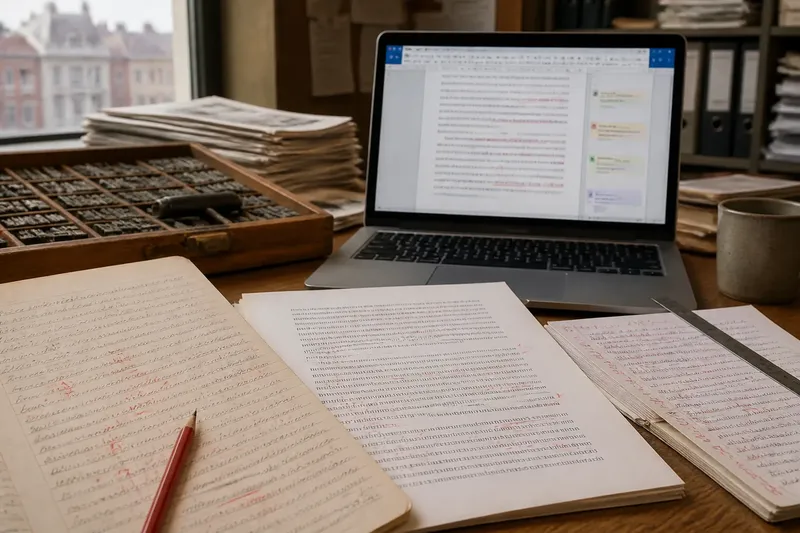
A marked sheet of copy could carry a story through a print office without anyone needing to stand beside it and explain every change. Before a newsroom desk became a familiar place for editing, copy preparation meant arranging words, signals and instructions so compositors could turn a manuscript into type. The move to digital publishing did not remove that work; it changed where decisions were recorded and how readily they could be revised.
To understand the shift, follow a piece of copy through its working life: from a writer’s manuscript, through editorial marks and production, to the flexible files and shared systems used for publication today. The history is less a simple march from paper to screen than a change in how people made their intentions visible to one another.
Copy before the desk
In an early print operation, a manuscript was not yet a page. It was material to be interpreted and set. Handwriting, spacing and punctuation might be inconsistent, while a compositor needed clear instructions about what words to use and how they should be arranged. Copy preparation therefore joined editorial judgement to practical production.
Editors and proofreaders used marks to indicate deletions, insertions, substitutions and paragraph breaks. These signs were a compact working language. A correction written above a line or in a margin had to be unambiguous enough for someone else to apply, often under the constraints of a busy print schedule.
Preparation could also mean making a clean copy from a rough draft, checking names and punctuation, and marking the parts that required special treatment. The printed result depended on several linked tasks: deciding what the copy should say, communicating that decision, setting the type and checking a proof. The person who changed a sentence might not be the person who assembled the page.
Marks as instructions
Editorial marks did more than tidy prose. They helped distinguish the text itself from directions about how it should be reproduced. A deletion mark told a compositor to remove material; an insertion showed what should replace it. A paragraph sign or instruction to begin a new line could affect the shape of the printed column as well as the reading.
The system relied on shared understanding. If a mark was unclear, a compositor might have to interpret it, ask for clarification or return a proof for correction. That made legibility and consistency practical necessities, not decorative conventions. Copy editors learned to make changes easy to locate and hard to mistake.
For a longer story, preparation might include identifying the order of pages or sections, marking a continuation, or noting where a heading belonged. Such directions connected writing to the physical page. They also made the copy a kind of handover document: the next worker needed the text and the instructions together.
Proofs and production
Once type had been set, a proof gave editors a chance to compare the printed representation with the intended copy. Proofreading could catch errors introduced during composition, along with missed slips in the manuscript. Corrections then travelled back to production for another change.
This loop made publication a sequence of dependent hand-offs. A correction made late could affect nearby lines or page layout, so changes had to be communicated in a form production staff could use. The proof was not simply a final reading exercise; it was a working surface shared by editorial and printing roles.
Newsrooms varied in their tools and division of labour, but the underlying challenge was familiar: preserve the intended words while preparing them for a particular means of publication. The page’s physical limits mattered. A change could alter line endings, column length or the position of material that followed.
From paper to screens
Digital editing loosened the connection between a correction and a fixed sheet of type. In a word processor, an editor could insert or remove text without rewriting a clean manuscript. Track changes and comments made revisions visible, while a shared file could carry both the copy and discussion about it.
Desktop publishing brought text and page design closer together. Editors and designers could see words in a layout rather than relying entirely on instructions passed to a separate typesetting stage. Later content-management systems separated the story’s editable fields from the page template, making it easier to prepare a version for a website without treating every item as a finished sheet of print.
That flexibility changed the timing of decisions. A digital story can be corrected after it appears, and an editor can update a name or clarify a sentence without recreating an entire page. But the ease of revision also means that versions can multiply: a draft in email, a shared document, a content system and a published page may all contain different text unless the newsroom keeps track of which one is authoritative.
A working week of copy
Think of a small newsroom preparing a reported feature for a print edition and its website. Its week is not a universal schedule; it is a useful way to see how older hand-offs survive inside newer tools.
- Early in the week: The writer prepares a clean draft and flags names, unfamiliar terms and passages that need a source check. The editor reads for meaning first, then marks unclear wording and factual questions in the working document.
- After the first edit: The writer answers queries and revises the copy. The editor reviews the changes rather than assuming every suggested edit was accepted, then clears comments that no longer need to travel with the story.
- During production: A print version is placed into a page layout, while the online version is entered into the content system. The editor checks that headings, captions and other supporting text belong to the correct version.
- Before publication: The team reads the page proof and previews the web presentation. A correction is entered in the relevant source, then checked in the output where readers will see it.
- After publication: If a substantive correction is needed, the newsroom updates the live story and follows its correction policy. It also checks whether a separate print version needs a notice or other action.
Imagine an editor changing a place name after confirming its spelling with the reporter. In a paper workflow, the change might be marked on a proof and sent back to the compositor; in a digital workflow, it might be corrected in the content system and checked in the page preview. In either case, the useful observable result is that the approved spelling appears in the version intended for readers, not merely in a comment or an abandoned draft.
What changed—and what did not?
The clearest difference is reversibility. Paper marks recorded a proposed change on a copy that might soon be typeset; digital tools let editors make, compare and sometimes undo changes within the working file. A screen can also show revisions and comments beside the text, reducing the need to decode a mark in a margin.
Yet digital editing has not made hand-offs disappear. Someone still needs to know which draft is current, which queries remain open and which version has been published. A polished document can still contain unresolved comments, and a correction in one channel can leave another version unchanged.
What is not worth the effort is preserving every obsolete draft as if it were a production record. Keep the approved version and any material needed to explain significant decisions; remove clutter that makes the current copy harder to identify. A newsroom’s retention rules may set different requirements.
How did copy preparation change?
What did copy editors mark on paper?
They marked changes to wording, punctuation, paragraphing and other instructions needed for setting type. The marks made editorial intent legible to the person preparing the printed page.
Why did printers use proofs?
A proof let the newsroom inspect type after composition and catch discrepancies before or during production. It created a shared place to identify corrections and send them back clearly.
What did digital editing make easier?
Digital files made revisions easier to enter, compare and distribute without recopying an entire manuscript. They also allowed text and layout to be checked together, though separate versions still needed active management.
Do print marks still matter?
They remain useful as a way to understand editing conventions and the history of production. In current work, digital comments, tracked changes and content systems usually carry those instructions, but the need for precise hand-offs remains.
Reading the workflow
The history of copy preparation is a history of making editorial decisions transferable. Paper marks joined a writer’s words to a compositor’s work; proofs linked the set type back to editorial intent. Digital files and publishing systems make those exchanges quicker to revise, but they do not decide which version is authoritative or whether a change has reached every output.
When you encounter a correction in a published story, remember that it may have passed through more than one working copy. The practical question is not whether a newsroom uses paper or screens, but whether its process lets people identify the approved text, see what changed and verify the version readers actually receive.