A Reader’s Route Through a Long News Feature
A reader’s route through a long news feature helps you use a short reading session well: spot its structure, follow its signposts and find the sections that answer its central question.
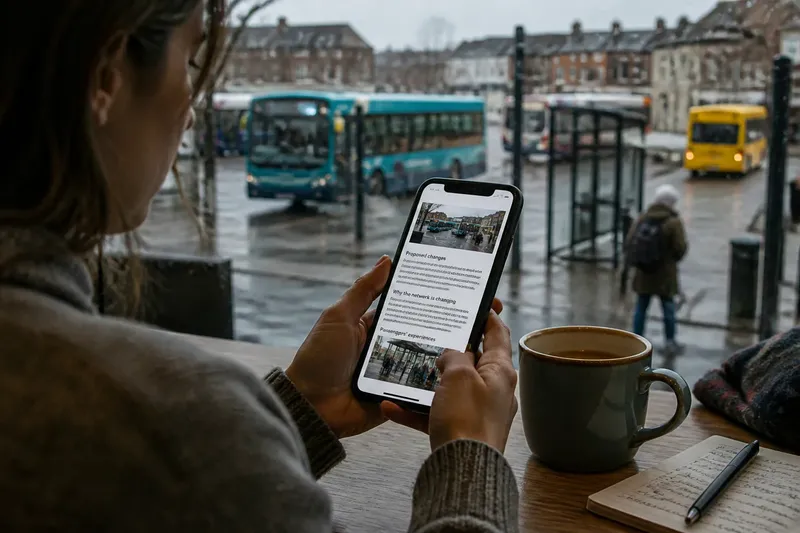
You have a cup of tea beside you, a long news feature open on your phone and only a short break before the next task. A reader’s route through a long news feature can make that session useful without pretending that a quick scan is the same as a full reading. The aim is to identify the article’s central question, see how its parts relate and choose where your attention should go next.
Imagine you have a few minutes to assess a feature about a town’s changing bus network. You want to know why routes are being altered and what the changes mean for passengers, but you cannot read every paragraph just now. Treat the feature as a route with signs, not as a wall of text: first inspect its shape, then read the opening, and then follow the sections most likely to answer your question.
Read the shape
Before settling into the prose, look at the title, standfirst, byline, publication date and any subheadings. These details help you identify the subject, the article’s framing and whether the material is current enough for your purpose. A feature’s length alone tells you little about how it is organised.
Next, scroll through the page at a measured pace. Notice where headings divide the text, whether there are pull quotes or image captions, and whether the article includes a timeline, map or other explanatory element. Do not assume that every visual item contains a separate argument: check its caption and where it sits in relation to the prose.
In the bus-network feature, you might see headings about the proposed changes, the reasons for them and passengers’ experiences. That rough map already suggests a useful distinction: one section may explain the decision, while another shows its consequences. Keep the distinction provisional until you have read the relevant passages.
It is not worth opening every photograph, expanding every related link or reading reader comments just to decide where to begin. Those may add context later, but they can divert a short session before you have worked out what the feature itself says.
Test the opening
Read the opening paragraphs rather than relying on the headline and standfirst alone. A strong opening usually establishes a scene, a problem or a question; the following paragraphs should make clear what the feature is trying to examine. Look for the people, places or decisions that give the subject its shape.
Then put the central question into plain words. For the imagined bus story, it might be: why are routes changing, and how will those changes affect passengers? This wording is your reading compass, not a claim that the article will answer both parts equally. The feature may concentrate on the reasons for the decision, or it may spend more space on daily effects.
Notice how the opening handles evidence and uncertainty. Does it identify who is making a claim, distinguish a proposal from a final decision, or signal that some consequences remain unclear? These cues help you avoid treating a vivid opening scene as proof of a broader pattern.
Follow the signposts
Subheadings are useful because they divide a long feature into sections, but their job is to guide rather than replace reading. A heading can tell you what a section is about; it cannot tell you how the writer supports the point or whether the section addresses your question directly.
Use the headings to select a reading order. If you need the reason for a policy change, go first to the part that explains the decision and the people responsible for it. If you need to understand its effects, move to the passages about passengers, access or travel routines. Then read the transitions around those passages so you can see how the writer connects them to the main argument.
Pay attention to repeated names, dates, locations and terms. A phrase such as “the revised network” may refer to a proposal in one section and an approved plan in another. When the distinction matters, return to the sentence that defines the status rather than relying on a later shorthand reference.
Captions and pull quotes can point towards useful passages, but they are selected elements, not a substitute for the surrounding text. A quote may capture a person’s reaction without showing what question prompted it. Read the paragraph around it before deciding how it fits.
Choose what answers
Once you have a rough map, choose sections according to the question you actually need answered. For a decision-focused question, look for the explanation of who made the choice, what reasons are offered and what alternatives are discussed. For a consequence-focused question, look for concrete accounts of how people are affected, alongside any wider evidence the feature provides.
In the invented bus-network situation, you read the opening and see that the article asks why a service is changing. You then read the section on the transport authority’s rationale and the section describing passengers’ journeys. The first gives you the stated reason; the second shows what the change could mean in practice. If those passages leave an important gap, you know precisely which part deserves a fuller return.
Keep claims attached to their sources. “The authority says the redesign will improve connections” is not identical to “the redesign will improve connections”. Likewise, one passenger’s account can make an effect vivid without establishing that everyone will experience it. These distinctions matter even during selective reading.
If the feature contains a chart, map or box, read its title, labels and note as well as the graphic itself. Check what area or group it covers and what comparison it makes. A visual can clarify a point quickly, but its scope may be narrower than the feature’s broader subject.
What should you read first?
Can I skip straight to a subheading?
Yes, if you first read the opening and can tell what question the feature is pursuing. Without that context, a selected section may be easy to misread as the whole story.
Do pull quotes summarise the article?
Not necessarily: they highlight selected lines and may represent only one voice or moment. Read the surrounding paragraphs to understand their context.
How do I tell what the feature has established?
Separate reported facts, attributed claims, personal accounts and the writer’s explanation. If a point remains unclear, return to the passage that gives its source or describes its limits.
When should I come back for a full read?
Return when the subject affects a decision you need to make, or when your first pass leaves a meaningful question unresolved. A focused session can orient you, but it may not reveal every qualification or connection.
Make a return route
Before closing the page, note the question you still have and the section that might answer it. A brief note such as “check whether the route change is approved” is more useful than saving the feature with no reminder of why it mattered. If you return later, begin with that passage and read enough around it to recover the argument’s context.
For the imagined reader, the first session has established that the feature distinguishes the transport authority’s stated reasons from passengers’ reported experiences. The reader can now return when time allows, read the full piece with that distinction in mind, and check how the writer connects the two strands. That is the practical value of a reader’s route through a long news feature: it turns limited attention into a clear starting point, while leaving room for the fuller account.
When you share or discuss the feature, describe the part you actually read and keep its qualifications attached. That small habit helps others understand whether you are passing on the article’s central argument, one section’s evidence or simply a question worth returning to.